

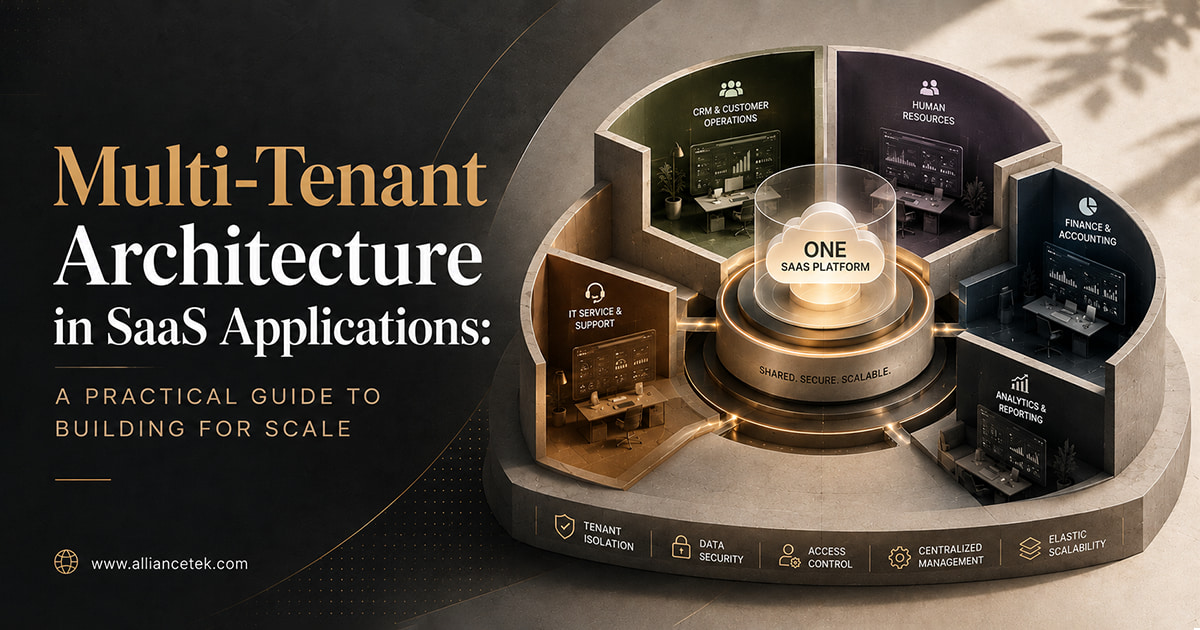
There have been major changes in the way businesses use and manage software due to the advent of Software as a Service (SaaS). Companies don’t need to install individual applications for each of their clients. They can run one platform serving many tenants. This kind of architecture is referred to as multi-tenant architecture.
The choice of architecture is important when developing products for multiple clients for businesses investing in SaaS development services. Multi-tenant architecture offers various advantages like better utilization of resources and easy maintenance. However, resource sharing also has some disadvantages like isolation, security problems, performance concerns, and compliance issues.
What Is Multi-Tenant Architecture?
Table of Contents
A multi-tenant architecture is a system that allows many tenants to use the same resources. It ensures that no information shared by the companies can be accessed by other companies.
For a clearer example, imagine an online software service that offers services related to client relationships. There can be many companies signing up for this service and using it. However, every single one of them will be able to see only its own unique data related to its own clients and personnel.
All of the companies use the same software platform as an underlying service.
How Does Multi-Tenant SaaS Architecture Work?
The application that uses the multi-tenant model recognizes its tenant at each of its requests and then determines which resources the user can access based on that information.
This is done through several steps and includes:
1. Tenant identification
Once a user is allowed access to the system, the application can tell which organization or company the user comes from.
2. Tenant provisioning
A new customer gets the required resources, configuration, users, and permissions.
3. Data partitioning
The data of different tenants is divided in some way, either using shared tables but separate schemas, shared databases but separate schemas, or even separate databases for each tenant.
4. Access control
A user should not be able to access any resources that belong to other tenants. Policies can be created that restrict a user’s access to resources depending on their company.
5. Customization
Some applications allow tenants to customize the application’s appearance, functionality, business processes, features, and connections.
6. Centralized management
The application can be upgraded, secured, monitored, and maintained from a central location for all tenants.
Consistency of the tenant context needs to be maintained throughout the process of passing data via APIs, databases, storage, cache, and background jobs. In case the tenant context is lost at any point during this process, then the application might mistakenly access or change the data of the wrong customer.
Tenant awareness becomes a critical aspect in designing the SaaS Application Development Services.
Common Multi-Tenant Architecture Models
Choosing the right solution depends on the number of users expected, required security and compliance, load, and overall complexity of operations in that company.
1. Database-per-Tenant Approach
In this approach, every customer has their own database. It allows for stronger isolation, which can help with backup procedures and compliance checks, but increases the overall complexity due to the number of databases to manage.
2. Schema-per-Tenant Approach
The Schema-per-Tenant solution utilizes the same database, but each user is allocated its own schema. This is an example where logical isolation is improved when compared to shared database solutions, while at the same time avoiding some of the complexities associated with dedicated databases.
3. Shared-Database Approach
The Shared-Database approach uses a single set of tables and isolates different tenants by their unique identifiers. It has great potential to reduce costs significantly while making it difficult to manage access and maintain data integrity.
4. Hybrid Multi-Tenant Architecture
The hybrid model combines different types of tenancy within a single SaaS solution. For instance, a smaller customer with a shared database and schema can be accommodated alongside an enterprise customer that requires an isolated database for compliance or performance reasons. While the flexibility is significantly greater, the hybrid design also makes the whole architecture more complex.
How to Choose the Right Multi-Tenant Architecture
1. Choose Database-per-Tenant For
The best option when customer isolation is a priority, when they need the ability to control and manage their data, comply with regulations, and have specific requirements for backups or recovery.
2. Choose Schema-per-Tenant For
A good choice when the customer needs more isolation than a shared database can provide but doesn’t need the full capability of having a separate database.
3. Choose Shared-Database For
When you need to reduce costs by maximizing the utilization of database resources, and your customers have less diverse and intensive needs.
4. Choose Hybrid Architecture For
It is the most flexible but complex option. It is suitable for situations where different customers have different requirements for security, compliance, performance, and resource needs.
Tenant Isolation and Security
Tenant isolation is essential to make sure that one customer cannot access or tamper with another customer’s data. The process of authentication identifies the user, and the process of authorization defines what resources this user can access. A multi-tenant system needs several security controls to protect tenant data and prevent unauthorized access across tenants.
Such policies may include:
- Role-Based Access Control
- Tenant Authorization via API
- Encrypting Data
- Logging and Audit Controls
- Row-Level-Security Mechanisms
- Backing Up Data Securely
- Cross-Tenant Security Testing Procedures
These policies should be built in from the start for Custom SaaS Software Development teams rather than being added later.
Scalability and the Noisy Neighbor Problem
Shared Infrastructure may lead to the noisy neighbor dilemma whenever one tenant uses more CPU, memory, database, or network resources exiling all other tenants to receive less service.
Thus, one must implement all necessary methods via load balancing, autoscaling, rate limiting, quotas, throttling, and tenant monitoring in order to achieve quality.
Lastly, there will be times when it would be necessary to provision specific resources for customers who do not have a normal workload.
Customization in Multi-Tenant Applications
It is common for clients to ask for different types of workflows, functionalities, branding, and integration. However, the downside of creating a unique code base for each client is that it creates management issues.
Using a configuration-based approach to customization enables an organization to offer:
- Custom branding
- Feature toggling
- Custom fields
- Configurable business processes
- Roles and permissions
- Tenant-specific integrations
Thus, it is worth considering Custom SaaS Development Services for companies that want to avoid heavy individualization of the platform for each customer.
Benefits of Multi-Tenant SaaS Architecture
Multi-tenancy can provide several advantages for SaaS platforms transforming education sector.
1. Lower Infrastructure Costs
Several customers can share the cost of the computing, storage, and network resources required to host the application, which reduces the infrastructure costs for individual organizations.
2. Simplified Maintenance
A common application can make it easier to install updates, patches, and new features for all customers.
3. Faster Customer Onboarding
The speed of onboarding can be improved through the automation of provisioning tenants.
4. Better Resource Utilization
Shared infrastructure makes it possible to allocate resources based on actual usage rather than the projected needs of individual customers.
5. Faster Product Development
A common codebase can make it easier to develop, test, and release new products and features to all customers.
Key Challenges in SaaS Application Development Services
Multi-tenancy also brings some challenges.
1. Security and Data Isolation
Systems need to be built in such a way that one customer cannot access another customer’s data.
2. Performance
Other customers can be negatively impacted if a customer is utilizing a large amount of resources
3. Compliance
Some industries require specific requirements to be followed relating to data encryption, data residency, data retention, and auditing
4. Customization
Too many customizations for individual customers may make the system difficult to manage or troubleshoot
5. Reliability
If the infrastructure fails, it will impact all customers
6. Monitoring
Systems should be created so that logs and metrics of each customer can be separated for quick troubleshooting.
Best Practices for Multi-Tenant SaaS Applications
When designing a multi-tenant platform:
- Choose the tenancy model based on specific requirements.
- Design isolation from the beginning
- Automate provisioning
- Utilize tenant-aware monitoring and logging.
- Implement quotas and throttling for controlling resource consumption.
- Focus on configuration vs custom coding when creating the software.
- Ensure the security of data using encryption methods, data access limitation, and backups.
- Implement disaster recovery.
- Perform continuous testing for cross-tenant vulnerabilities.
- Scale for growth in users, tenants, transactions, and storage capacity.
SaaS Consulting services can also assist in assessing the architectural decision. Build the software as multi-tenancy, single-tenancy, or hybrid solutions if the venture wants to investigate some aspects of security, scalability, and compliance.
Conclusion
Modern software as a service (SaaS) solutions rely heavily on multi-tenant architecture. This kind of architecture allows for the use of one application infrastructure to serve many customers while ensuring certain levels of customer isolation, which results in decreased costs, improved productivity, quicker onboarding, and the possibility of scaling.
However, selecting this architecture does not offer any guarantees for success since all the necessary factors should be taken into account during the process of software design and building in order to ensure issues like security and isolation, scalability, performance, customizability, compliance, monitoring, and recovery.
All these aspects need to be taken into consideration when selecting the architecture of your product. The decision about the architecture selection needs to be made based on the expected customer base, security issues, compliance issues, performance, and business goals.
FAQs
1. What are SaaS development services?
SaaS development services are part of software development that deals with the design, development, testing, implementation, and maintenance of cloud-based software. It entails application development, creation of Database Architecture, API development, Authentication, Cloud Infrastructure development, and maintenance of the services.
2. When to use custom SaaS application development?
Custom SaaS application development services are required when a company needs a cloud-based solution that is specifically suited to its needs regarding unique processes or integrations and results.
3. What should the company look for in a SaaS software development company?
The best SaaS software development company comprehends the entire process of designing cloud applications, including an understanding of cloud infrastructure and knowledge about databases, APIs, security, multi-tenancy, and software development in general.
4. When does a company need to hire a SaaS developer?
In case the company requires assistance in development of a cloud-based application, SaaS developers will be needed in order to help the company in creating, designing, testing, and maintaining the cloud-based software.
5. What are Enterprise SaaS Solutions?
Enterprise SaaS Solutions consist of cloud-based software applications designed and developed to deliver greater functionality for enterprises with enhanced security, organizational, and scalability needs.

